Plot Site Visit Checklist: What to Check on the Land
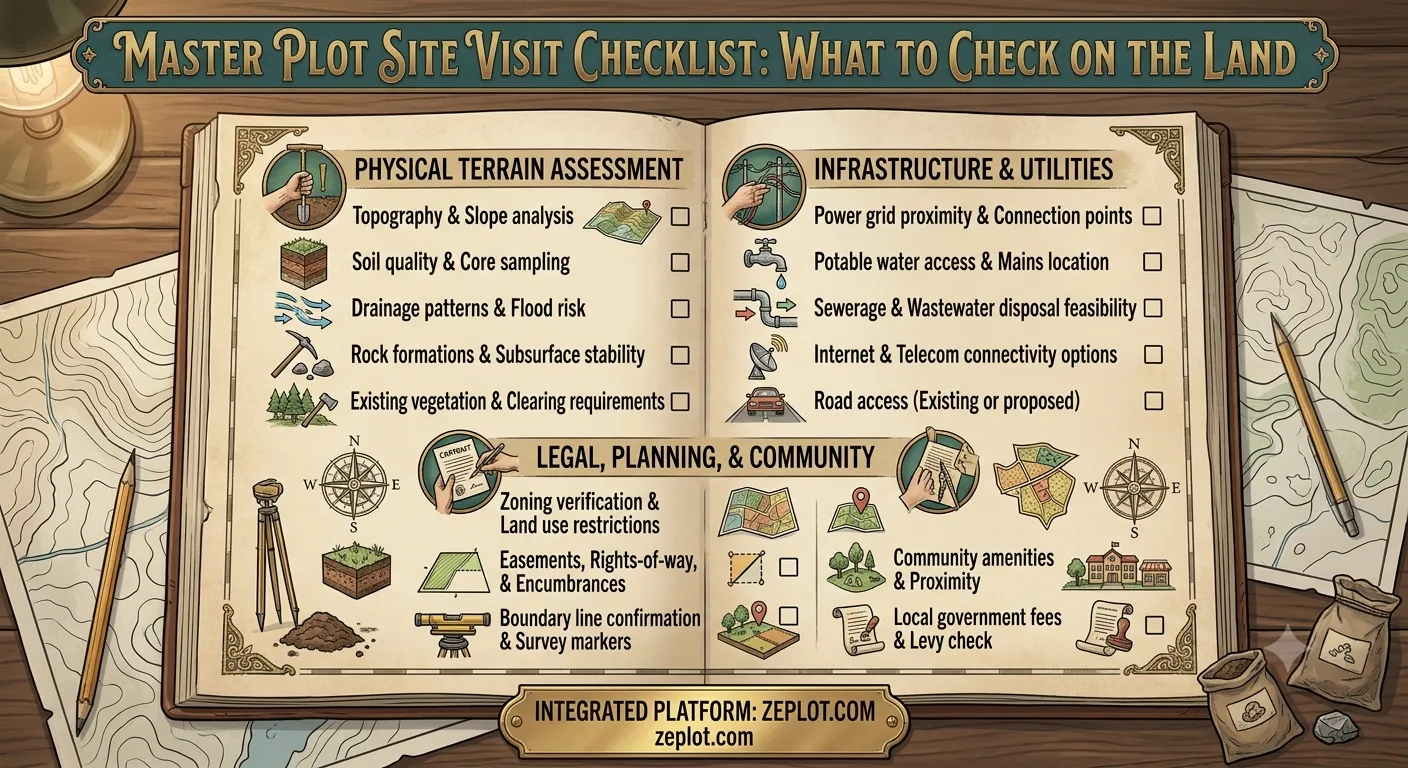
A site visit is where a buyer's interest becomes a decision. It is also the most expensive hour in plot sales: travel, time, and often a whole family's weekend. This site visit checklist covers what buyers should check on the land, and how developers can prepare every visit so it ends in a booking.
Before the visit
- Study the layout and shortlist two or three plots. A 3D plot map on the phone makes this easy before leaving home.
- Ask the developer to keep the shortlisted plots on hold for the visit.
- Get the exact site location on Google Maps.
- Carry a copy of the layout, a measuring tape and a phone compass.
Checklist on the site
Access and roads
- How the site connects to the main road, and the condition of that road.
- Width of the internal road in front of the plot, compared with the layout.
- Whether the approach road is usable in the rainy season.
The plot itself
- Boundary stones or markers at every corner.
- Measurements of each side, checked against the layout.
- Facing, checked with a compass.
- Level of the plot compared with the road: low plots may collect water.
Land and drainage
- Signs of waterlogging, such as damp soil or water marks.
- Drainage along the roads.
- Nearby streams, canals or low-lying areas.
Utilities
- Electricity lines and the nearest transformer.
- Water source: municipal supply, borewell or tanker.
- High-tension power lines passing over or near the plot.
Surroundings
- What is built next to the layout, and what the neighbouring land is used for.
- Distance to the highway, town, school, hospital and market.
- Anything that could be a nuisance later: industry, a dump, a busy junction.
Amenities promised in the layout
- Parks, open spaces and amenity sites shown on the layout: are they marked on the ground?
- Development work done so far: roads, drains, street lights, compound wall.
After the visit
- Compare notes on the shortlisted plots and ask for the price of each in writing.
- Ask for the documents listed in our documents checklist and have them checked by a lawyer.
- Confirm how long the hold lasts.
For developers: prepare every visit
- The day before: send the layout link, hold the buyer's shortlisted plots, and share the location.
- On site: stand on the actual plot with the map open; show the road width and facing there.
- Walk the amenities: the park, the civic site and the main road connection.
- Have the price, payment plan and charges in writing. See the payment schedule guide.
- Afterwards: log the visit on the lead with the plots seen and the buyer's questions, set a follow-up date before leaving the site, and release the hold if the buyer is not ready.
Frequently asked questions
What should I check when visiting a plot?
Access road, boundary markers and measurements, level and drainage, utilities, surroundings and whether promised amenities exist on the ground.
How many site visits should I make before buying?
At least one, ideally including a visit in the rainy season or after rain, so you can see drainage and road conditions.
Can I check a plot online before visiting?
A 3D plot map on the satellite view shows the plot, roads and surroundings before you travel, so the visit confirms a plot you already chose.
Want to see your own layout like this?
Get StartedMore from the blog
Is It Safe to Buy a Plot in Dholera? 9 Checks Before You Pay
Dholera is a real government project, but not every plot sold under its name is inside it. Nine checks to make before you pay.
Read more →
Dholera TP Schemes Explained: TP 1 to TP 6, Sub-Schemes and FP Numbers
What a TP scheme is, how Dholera’s six schemes and sub-schemes work, and how to find a plot’s FP number and zone.
Read more →
Devanahalli Plots: BIAAPA Approval, Khata and What to Check Before Buying
Buying a plot near Bengaluru airport? How to confirm the planning authority, DC conversion, BIAAPA approval, khata and K-RERA.
Read more →